Thursday, April 7, 2016

Our Aging Water Infrastructure

Over the course of this semester I've talked about pretty specific instances of water crisis in America. Issues that involve one town, one group of people, or one state. This may make it easy to push the idea of water scarcity or increasing water costs to the back of your mind. This concluding post is here to promote the fact that, as a nation, we are approaching a difficult hurdle in our water sector. Our water systems, like the water mains and the pipes that bring clean drinking water into homes, are facing a difficult crossroad. Many of the pipes that we rely on today were installed in the 19th and earlier 20th century. Up until now, these pipes have been fine, functioning exactly as needed. However, every product, even metal pipes, have a usable lifespan. We are quickly approaching the usable lifespan of our water pipes. There are an estimated 240,000 water main breaks in the US per year, a number which may be difficult to comprehend. To put this into perspective, combining water main breaks and pipe leakages (from old age), the city of Atlanta is losing 31.4% of its water. Cleveland, Philadelphia, and Pittsburgh aren't much better, losing 28.7%, 26.5%, and 26% respectively. In 2013, the American Society of Civil Engineers' gave the United States' water infrastructure a D+. As college students, the sight of this grade probably makes us recoil a little in fear.  If the US was taking 'water infrastructure' as an entrance to major course, it would have to retake it.

Water main break outside of UCLA
Image Courtesy of KTLA

How did we let this happen? The trend of ignoring our infrastructure is very popular in America. 'If it's not broke, don't fix it' is a common adage, and is unfortunately applied liberally when dealing with the systems that we rely on daily. If the bridge hasn't collapsed yet, why fix it? Similar calls are being made with our water systems. Until giant geysers spring out of the street, it is all too easy to ignore what is happening. It doesn't help that there really isn't the sort of money being spent on water infrastructure that there needs to be. The 2013 report from the American Society of Civil Engineers projected that over a trillion dollars needs to be spent to repair the aging systems that we rely on so much. 

Since raising utility costs is an unpopular political move, municipalities never have enough money to repair systems. At some point people are going to have to start picking up the slack, and when they do, utility bills are likely to see pretty substantial increases. A household of three could expect to be paying as much as $550 more per year than they currently do, just because of infrastructure repair. This increase is highly dependent on system size, which makes sense. Highly spread out systems (like in rural areas) will be facing a larger per-person cost than highly concentrated water systems (like cities), due to the fact that a longer length of pipe will need to be replaced per person. And even if all of the currently aging pipes are replaced, soon enough the next batch of pipes will be needing replacing. The costs keep coming. Our infrastructure is being ignored, and the longer we ignore it, the more it's going to cost us. 

Postponing the investment in water infrastructure only makes things worse. It increases the possibility of high-cost water main breaks, breaks which disrupt businesses and homes, damages property (think big sink holes), and has public health risks. When a main breaks, the water quality is compromised, as toxins are able to seep into the water that eventually comes out of taps. While it is not on the same level as the crisis we've seen in Flint or other cities with high concentrations of dangerous metals, long term exposure can still have a detrimental effect on our health.

Water main break in Scranton, PA leads to a very icy situation
Image Courtesy of citizensvoice.com

We have reached the so-called 'replacement era' for our water systems. As a Nation, we have two possible choices. Either take on the higher costs of water now to fix our poor pipes, or wait ten more years, when the costs will only be higher. It seems like a pretty easy choice, but we aren't making it. However we are getting closer and closer to a point where we cannot ignore it any longer, and the choice will be made for us. After all, it can be pretty hard to ignore a huge stream of water flooding your front lawn.

Monday, March 21, 2016

The Driest in 500 Years

For California, the beginning of 2013 was the driest start to a year in the 118 years the state had been doing record keeping. Fast forward to March 2016, and the US drought monitor map for California looks like this. Indeed, California is the driest it has been in 500 years.
US Drought Monitor for the State of California
Image Courtesy of NOAA, USDA, and NDMC
A drought is a "period of below-average precipitation in a given region, resulting in prolonged shortages in its water supply." So it's not like there can be no rain in a given area, it's just that what does come from the sky is less than what normally comes from the sky. In fact, there have been some rains recently, but nothing near enough to bring California back to normalcy. These long term droughts can bring about a lot of issues, which is why California declared a state of emergency on January 14th, 2014 due to the drought.

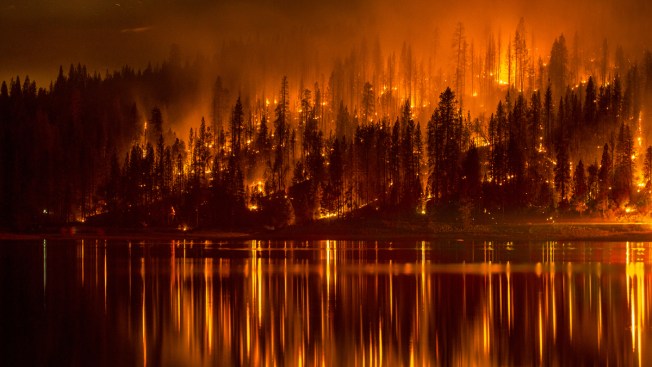
One issue that rides behind droughts are forest fires. Thanks to the continually dry weather, trees (and other plants) aren't able to take in as much water as they require, causing them to become drier than usual. Additionally, drier air causes more and more water to evaporate from the trees, only making the problem worse. Simplistically, the drier and hotter it is, the more forest fires you'll get. Typically, when something like lightning hits a tree, sure that tree goes away, but nothing much else happens to the area. But when everything is bone dry, that initial lightning strike turns into a massive blaze. In September of 2015, three fires were burning simultaneously, wiping out more than 270,000 acres of forest. The drought, as a whole, has killed (not just burned) 12.5 million trees. These trees will sit on the hills of California even as this drought ends, providing plenty of fuel for future fires. The drought will have a long term impact on the frequency and the severity of forest fires in California.

Forest Fire on Sunday, Sept. 14 2004
Image Courtesy of AP
These fires burn through anything in their path, chewing up homes and killing the unfortunate individuals who were not able to evacuate in time. 

The aquifers of California will also be taking a huge, long term hit thanks to the drought. An aquifer is a layer of permeable rock that is able to take in and store water, water that we can then be brought up via wells. This so called 'ground-water' accounts for about 60% of California's water supply. And thanks to the drought, California has drained 41 trillion gallons of ground-water from their aquifers in the central valley.

The Central Valley
Image Courtesy of Visit Central Valley
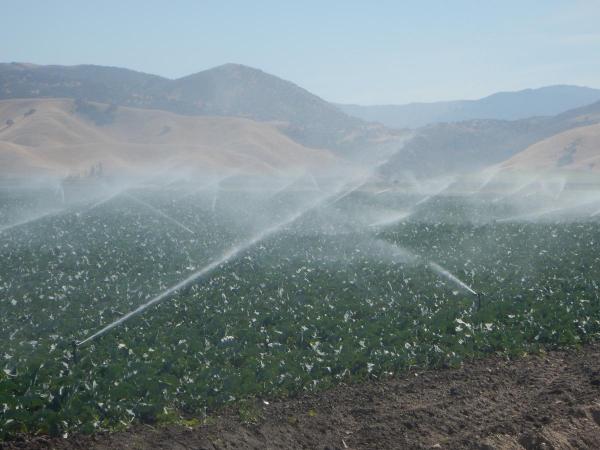
So much water has been pumped out due to the crops that are grown in this region. The crops (things like almonds, pomegranates, artichokes, and kiwis) are notoriously water greedy, and will die if not given enough water. And thanks to the limited restrictions on how much water a farmer can pull out of the water table, they'll just keep pumping it up to keep their crops alive.

Freshwater being wasted on crops
Image courtesy of Ocean Futures Society
The most frightening fact about these aquifers is that they are not easily replenished. Even with high rainfalls, aquifers will take thousands of years to replenish. The more and more farmers pump, the lower and lower the water table gets. Farmers who were used to drilling 200 foot wells are now having to resort to 1,000 foot (and deeper) wells to reach the water. The declining water table of the California central valley is illustrated in this figure.

California Water Table level (red means decrease) from 2011 to 2012 to 2013
Image Courtesy of Nature.com
So even if this drought ends this year thanks to the El NiƱo, the water table will still be in a dismal state.

So what exactly is California doing to help relieve the stress on it's water crisis? For one, Governor Edmund G. Brown instituted a 25% water savings mandate in 2015 that has been successfully met for 7 months in a row. Additionally, the state is investing money in projects like improved irrigation systems for farms to decrease water usage. Desalination plants are also being built to try to supply California with enough fresh water, but this becomes very costly as it requires large inputs of electricity.

Hopefully this season gives California some much needed rescue, but for now it is much too soon to tell what lies ahead in California's drought crisis. However, even if California exit's its drought, there are still many long term effects of the drought that will plague the state for years to come. 


Wednesday, March 2, 2016

Ignored by the Media

Thanks to the concentrated media spotlight stemming from the scandalous nature of the Flint water crisis (of which I talked about in my first post), almost everyone has heard about the plight of the predominantly low income inhabitants of the Michigan town.

Thanks to the lack of attention from the main stream media (that some say arise due to the long term effects of social bias), I'm sure almost nobody has heard of the long standing water crisis plaguing Native Americans in the west and south west regions of America.

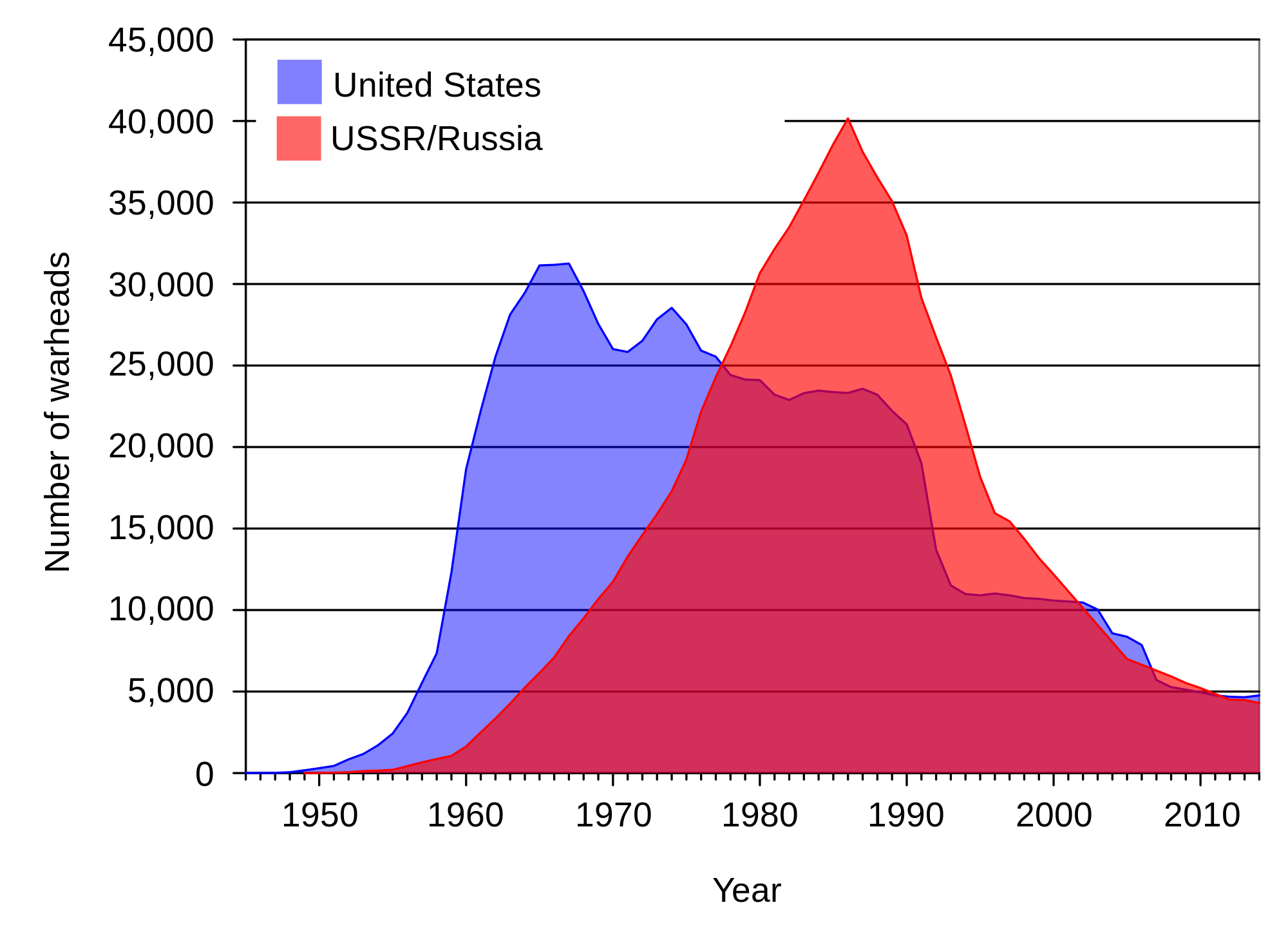
The nuclear arms race of the Cold War caused a drastic and frightening increase in the production of nuclear weapons in America. In the 1960's America had a peak stockpile of over 30,000 nuclear warheads.

Nuclear Arms Race Warhead Arsenal
Image Courtesy of Wikimedia Commons
And in order to produce all of these weapons, uranium is needed. Lots of lots of uranium. And in order to ensure that there was enough uranium to produce all of these warheads, light regulations from the 1800s were still in place that did not take into account the dangers of mining things like uranium. The most impactful of these is the General Mining Law of 1872, which made it so that mines did not have to "undergo reclamation or remediation", which pretty much means that mine owners did not have to clean up after themselves. Already this does not seem like a good idea, and then when you consider just how much uranium was coming out of these mines, the whole situation gets much worse.

Uranium production in tons per state
Image Courtesy energy.gov
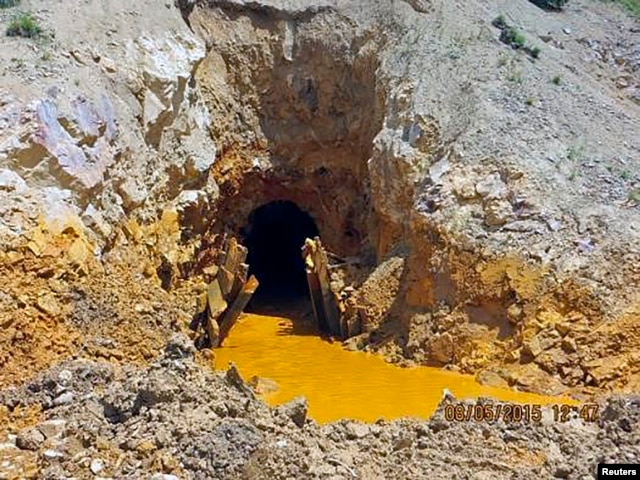
Some of the abandoned mines that resulted when the US got less 'nuke crazy' are just that: abandoned. The owners didn't have to clean up, so they just stood up and left, leaving radioactive waste and gaping holes in the ground. Take this abandoned mine in San Juan County, Colorado. The bright yellow waste water that leaches out of the mines is referred to as "the yellow monster" by the Navajo people who live near them. At a October 2008 House Oversight Committee hearing, a local, Ray Manygoats recalled how his sister accidentally "walked through one of the open ponds near the mill and burned her feet." He now suffers from numerous health problems as a result of his life near the mine.

Image Courtesy of Reuters
This radioactive waste can find it's way into the drinking supply of the people who live nearby, leading to uranium concentrations four times the federal limit. While much of the uranium one takes in is excreted, a portion of it remains in your body, causing kidney damage. Acute exposure to the metal causes other health effects like significant weight loss or hemorrhages.

In addition to these abandoned mines, there is still uranium mining going on in northwestern Nebraska using a technique called in situ leaching, which is injecting oxygenated water into the ground to dissolve the ore, and then bringing the uranium-water solution back to the surface to extract and process the metal. The safety of such a technique is currently being debated (it is questionable whether mining operations can capture all of the solution), but a nearby group of the Oglala Lakota people are saying it is responsible for high rates of cancer and kidney disease.

And it doesn't stop with uranium. Other mining operations that procure metals like copper utilize acidic solutions to most efficiently and quickly gather ore, and the waste of these operations can leach into water, leading to disasters like the Gold King Mine spill in 2015, which turned an entire river bright yellow.

Animas River in Colorado
Image Courtesy of Jerry McBride
The Native Americans have been hard at work protesting the issues at hand, but provisions that allow for continued as well as new mining operations on federal land continue to be slyly tucked into large documents in order to sneak them past Congress and the tribes. For example, a provision allowing for the creation of the "continent's largest copper mine" in a national forest in Arizona (which was protected Apache land) was sneaked into a document that funds the Pentagon.

The main stream media decides not to cover much of the plight of the Native Americans who are trying to prevent such measures to occur. Not even large protests in Washington DC get any media coverage. This is contrast to the huge media outcry brought by the Flint, MI crisis. I won't get political about whether this is due to long standing discrimination or mainstream media's love of a juicy story, but it certainly shows that there are crisis' happening right now that receive little to no coverage, and therefore little to no acknowledgement.

Thursday, February 11, 2016

The Cost of Cheap Energy?

First you drill a big hole. Then you shoot high pressure water into the hole. Then you get natural gas! Then you contaminate the water supply?

Fracking has reduced natural gas prices by 47%, compared to what it would have been if fracking hadn't entered into the equation. Fracking has dropped gas bills $13 billion (about $200 per year). Fracking is helping the US move towards energy independence in as little as four years

Image Courtesy of Brookings
But is fracking contaminating drinking water and poisoning those who live around the drilling pads? It depends who you talk to.

If you ask the EPA, they say that it is largely safe, but name specific instances where groundwater contamination have occurred. Due to the very large number of wells compared to the ones that contaminated water, the EPA states that "hydraulic fracking activities in the US are carried out in a way that have no led to widespread systemic impacts on drinking water resources." So while there are still potential vulnerabilities in the procedure of fracking, there should not be such a large concern about the overall safety of fracking. All of this comes from a recent (June 2015) study. However, there are potential concerns with the study itself, namely the fact that the EPA did not have good pre-fracking water data from each of the areas they looked at, making it quite difficult to accurately assess whether the act of fracking had a detrimental affect on the water supply.

If you ask the companies doing the fracking, of course they say that, if done properly, it has no effect on the groundwater around the wells. One website cites geologist and Governor of Colorado John Hickenlooper: "...we can't find anywhere in Colorado a single example of the process of fracking that has polluted groundwater." They further cite the strenuous lengths that companies take in order to ensure that groundwater is protected; things like 'back flow preventers' to ensure one-way water movement through the well and steel / cement shielding along the interior of the well in order to separate the gas production and the environment. You can see a diagram of some of these practices in the image below (click the link in the caption to see a larger image). Whether measures like these are in fact effective in protecting groundwater may still be up for debate, but it still shows that most companies dealing with fracking are putting in a good faith effort to prevent water contamination.

Image Courtesy of energyfromshale.org
If you ask the people who live around these fracking wells, you'll get a completely different story than the ones I've told before. Public Herald, a non-profit news organization, claims that the Pennsylvania Department of Environmental Protection has gotten 2,309 complains about water in 43% of the counties in which fracking has taken place. A map that charts these in Northeast Pennsylvania is below.

Image Courtesy of BH/NY Friends of Clean Air and Water
Homeowners are also showing water from drinking wells near fracking sites have dissolved methane or other chemicals from fracking, resulting in murky water and odd smells. The methane that may be entering these people's water supply hasn't been imbued with sulfur, meaning that they might not even know if methane may be in their water, as it is odorless.

Water from drinking well near fracking site
Image Courtesy of ecowatch.com

Whether these cases are in fact due to inherent dangers involved in fracking, or whether they are due to carelessness that is allowed to continue due to improper regulation on the industry is a major question that still needs to addressed. The EPA is unable to make definitive conclusions on the topic due to lack of data at this time, and third party sources are not putting out solid claims that they are able to definitively back up. While it cannot be denied that there have been cases where water contamination has been an issue, is it a reason for America to stop the practice? Or is it a signal for lawmakers to ramp up their game and better regulate the industry?

Wednesday, January 27, 2016

A State of Emergency

America is the land of prosperity. It is the land of opportunity, of the best colleges, of the best health care. If this is true, then how did this happen to the town of Flint?

The Water Flowing Out of Taps in Flint, MI
Image Courtesy of Flint Journal
This is the water flowing out of the taps of 100,000 resident's homes in the town of Flint, Michigan. Something is clearly not right. Clean water is undeniably crucial to ensure people's safety and health. Clean water is so important that the United Nations agreed that clean water is a human right in 2002.

From a distance, a casual observer might suppose that this water had dirt in it; maybe a pipe had fractured and was allowing dirt to seep into the supply. If only this were the case. Upon testing, the water showed significantly elevated levels of lead.  You know, the heavy metal that caused a frenzy years back when children's toys were painted with cheap paints that contained the metal. The maximum concentration in water allowed by law is 15 parts per billion. Flint water was showing numbers like 400. Children are particularly susceptible to the affects of lead due to their growing bodies. Children with lead poisoning can have things like a lower IQ, hearing problems, slowed growth, according to the EPA. As of now, about 200 children in the Flint area have been shown to have elevated blood-lead levels. It is however too early to tell the true affects of the lead-poisoned water.

If this doesn't sound bad enough, there have been at least 87 cases of Legionnaires' disease in Flint in the past 17-months. Legionnaires' is a "severe, often lethal, form of pneumonia" caused by Legionella pneumophila, a bacteria found in potable water systems, according to legionella.org. Don Kooy, head of the McLaren hospital in Flint, MI, said that he and other experts think that the outbreak was caused by the city's dangerous water.

But how did it get this far? How, in America, were children being poisoned by the water running out of their tap?

To get to the bottom of it, we have to go back to 2014. Before 2014, Flint was buying water from the Detroit water supply, and everything was dandy. The water contained a chemical called orthophosphate, which prevented lead from the pipes from leaching into the water. Then, in an attempt to save money, the city wanted to start to use water from it's own river. Not only did their water not contain the orthophosphate, it also had eight times the chlorine levels that Detroit's water had. Chlorine is a corrosive to metal; so when Flint started flowing their water through the pipes, it corroded the pipes, leaching iron and lead into the water supply.

Image Courtesy of time.com
Back in October, Flint finally switched back over to Detroit water, but it was too late. The water is still very unsafe to drink. The image below shows the progression of water samples from January 15th to January 21, 2015.

Image Courtesy of FlintWaterStudy.org
On the 16th of January this year, President Obama declared a state of emergency in Flint, authorizing FEMA to use funds for disaster relief. You normally see FEMA use funds for hurricanes or tornados, not the incompetence of city governance. While the governor of Michigan, Rick Snyder has apologized, and called his delay in response "inexplicable and inexcusable," he has neither resigned or found a satisfactory solution for the citizens who still have no clean water to drink, besides bottled water. While Flint is planning on joining a new water authority, they must wait for a pipeline to be built, a pipeline which is planned to be completed in June 2016.

This story shows a stark reality for America. Water isn't a given, water isn't some liquid that magically shoots out of your tap perfect and safe to drink. Water is a commodity that must be carefully considered and carefully monitored, even in a developed country like America. Here we have a city of 100,000 people (to put it in perspective, State College has a population of ~42,000), where safe water for bathing, drinking, and cooking must be brought in bottles by disaster relief groups. Water needs to be thought about; water needs to be appreciated.