 |
| US Drought Monitor for the State of California Image Courtesy of NOAA, USDA, and NDMC |
A drought is a "period of below-average precipitation in a given region, resulting in prolonged shortages in its water supply." So it's not like there can be no rain in a given area, it's just that what does come from the sky is less than what normally comes from the sky. In fact, there have been some rains recently, but nothing near enough to bring California back to normalcy. These long term droughts can bring about a lot of issues, which is why California declared a state of emergency on January 14th, 2014 due to the drought.
One issue that rides behind droughts are forest fires. Thanks to the continually dry weather, trees (and other plants) aren't able to take in as much water as they require, causing them to become drier than usual. Additionally, drier air causes more and more water to evaporate from the trees, only making the problem worse. Simplistically, the drier and hotter it is, the more forest fires you'll get. Typically, when something like lightning hits a tree, sure that tree goes away, but nothing much else happens to the area. But when everything is bone dry, that initial lightning strike turns into a massive blaze. In September of 2015, three fires were burning simultaneously, wiping out more than 270,000 acres of forest. The drought, as a whole, has killed (not just burned) 12.5 million trees. These trees will sit on the hills of California even as this drought ends, providing plenty of fuel for future fires. The drought will have a long term impact on the frequency and the severity of forest fires in California.
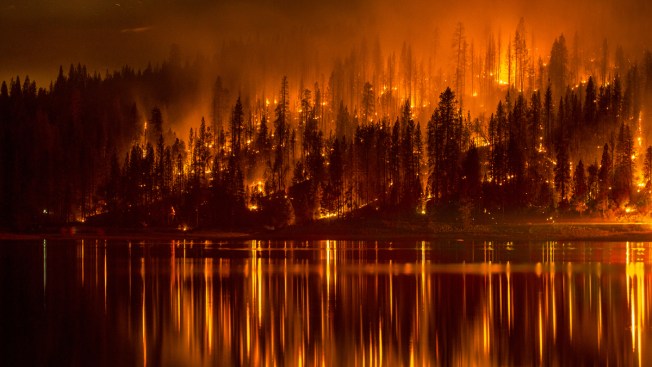 |
| Forest Fire on Sunday, Sept. 14 2004 Image Courtesy of AP |
These fires burn through anything in their path, chewing up homes and killing the unfortunate individuals who were not able to evacuate in time.
The aquifers of California will also be taking a huge, long term hit thanks to the drought. An aquifer is a layer of permeable rock that is able to take in and store water, water that we can then be brought up via wells. This so called 'ground-water' accounts for about 60% of California's water supply. And thanks to the drought, California has drained 41 trillion gallons of ground-water from their aquifers in the central valley.
 |
| The Central Valley Image Courtesy of Visit Central Valley |
So much water has been pumped out due to the crops that are grown in this region. The crops (things like almonds, pomegranates, artichokes, and kiwis) are notoriously water greedy, and will die if not given enough water. And thanks to the limited restrictions on how much water a farmer can pull out of the water table, they'll just keep pumping it up to keep their crops alive.
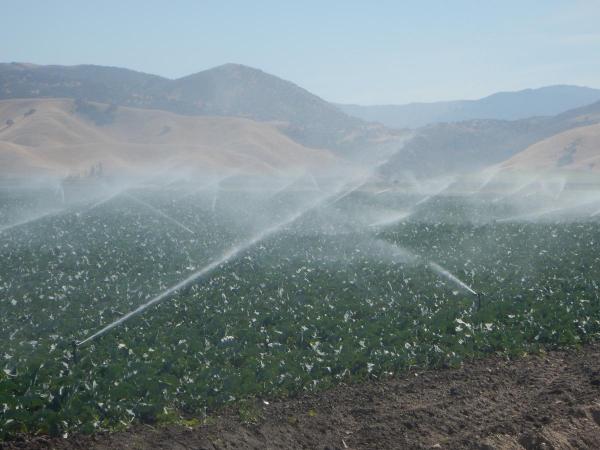 |
| Freshwater being wasted on crops Image courtesy of Ocean Futures Society |
The most frightening fact about these aquifers is that they are not easily replenished. Even with high rainfalls, aquifers will take thousands of years to replenish. The more and more farmers pump, the lower and lower the water table gets. Farmers who were used to drilling 200 foot wells are now having to resort to 1,000 foot (and deeper) wells to reach the water. The declining water table of the California central valley is illustrated in this figure.
 |
| California Water Table level (red means decrease) from 2011 to 2012 to 2013 Image Courtesy of Nature.com |
So even if this drought ends this year thanks to the El Niño, the water table will still be in a dismal state.
So what exactly is California doing to help relieve the stress on it's water crisis? For one, Governor Edmund G. Brown instituted a 25% water savings mandate in 2015 that has been successfully met for 7 months in a row. Additionally, the state is investing money in projects like improved irrigation systems for farms to decrease water usage. Desalination plants are also being built to try to supply California with enough fresh water, but this becomes very costly as it requires large inputs of electricity.
Hopefully this season gives California some much needed rescue, but for now it is much too soon to tell what lies ahead in California's drought crisis. However, even if California exit's its drought, there are still many long term effects of the drought that will plague the state for years to come.

Really effective use of images in this post - the drought map really puts California's horrific water situation into perspective. It's often hard for people who aren't directly impacted to really understand what's going on and how serious it is, but this post helps.
ReplyDeleteI wonder how much of an impact this drought has had economically on the entire U.S. Have the costs of the crops you mentioned (kiwi, artichokes, etc.) gone up across the U.S.? Have we had to decrease our exports?
ReplyDeleteAs Luke pointed out, the maps and geographical images you included did wonders for your post. I've heard so much about the CA Drought, but I never really knew that much about it. I'm glad you were able to but the issue in perspective and also mention how some of the solutions are being pursued, even if one is basically just waiting for El Niño and hoping.
ReplyDeleteI've lived in central California, so I have experienced the drought firsthand. From what I know, I don't know that there is any real solution for California, no matter what water restrictions are put in place. There are just too many people and crops in areas that lack the water to support them. A functional solution would drastically alter the face of California.
ReplyDeleteI previously heard about the drought problem in California but haven't heard much about it in so long I forgot about it. What will be the long term implications of these droughts and why are they severe now?
ReplyDelete